
Quality Control Checkpoints a Trained Brand Team Can Run Itself
A brand team cannot perform a factory's quality function, and it should not try. What a trained team can do is run its own checkpoints at the six or seven points where a fragrance project is easiest to lose, using reference samples, written criteria and a camera rather than a laboratory. For a direct-to-consumer brand, these brand-side gates are the difference between catching a drift while a batch is still in the factory and discovering it in the returns dashboard.
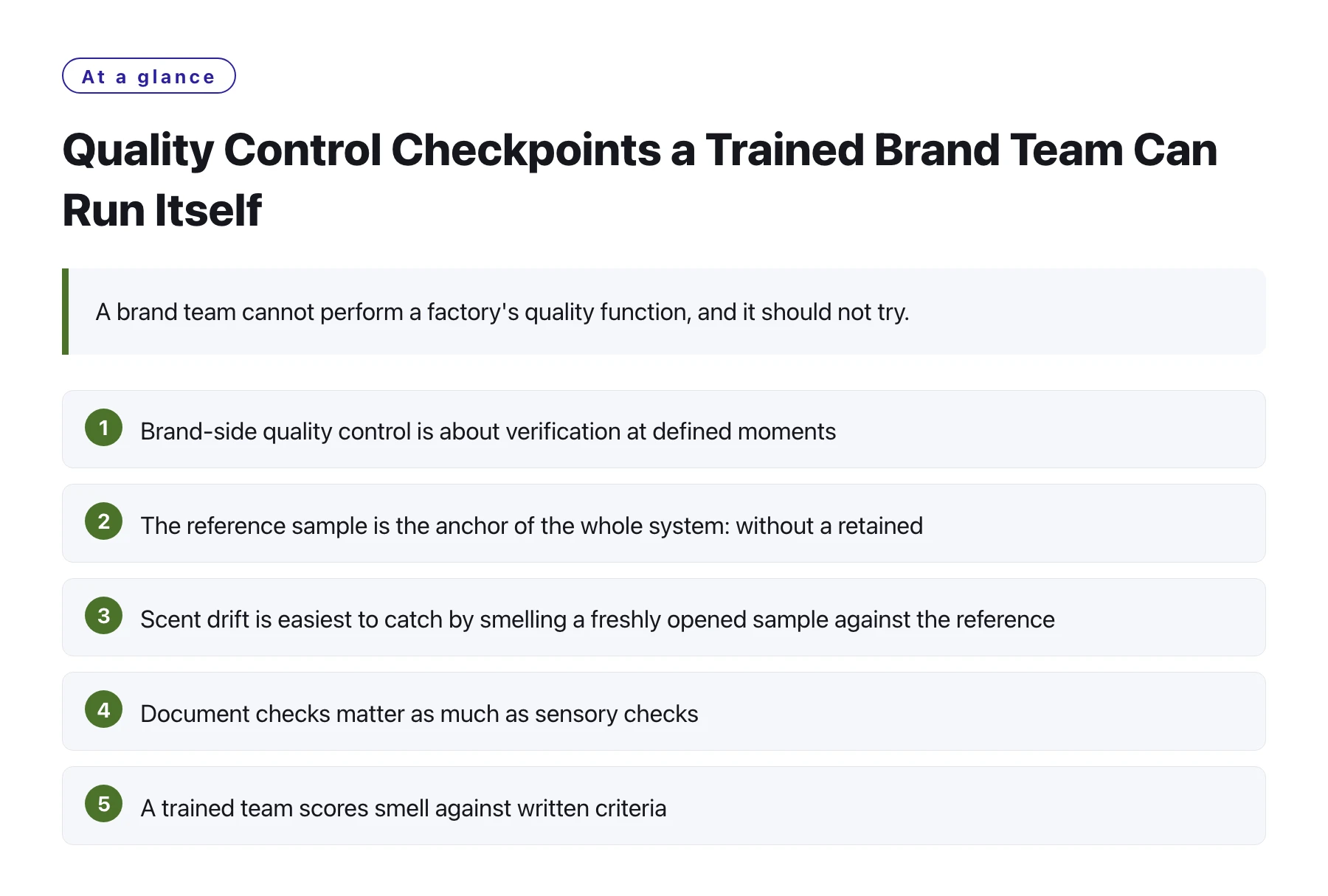
Key takeawaysBrand-side quality control is about verification at defined moments, not about duplicating the manufacturer's testing. · The reference sample is the anchor of the whole system: without a retained, labelled reference the phrase approved batch means nothing. · Scent drift is easiest to catch by smelling a freshly opened sample against the reference, in a consistent place, at a consistent time of day [1]. · Document checks matter as much as sensory checks, because a batch record that does not match the shipped quantity is an early warning that something else does not match either. · A trained team scores smell against written criteria, which turns a subjective disagreement into a specific, arguable observation. · Test reports commissioned for a formula and package are the evidence behind a release decision, and they should be read rather than filed [2].
Most quality problems in a first fragrance order are not dramatic. They are small: a bulk batch that reads slightly thinner than the approved sample, a pump that dribbles on one in fifty units, a label applied a millimetre low, a carton that arrived with the wrong inner dimension. Each is survivable in isolation. Together they form the pattern that shows up in reviews and returns, and none of them is caught by a team that only looks at the finished pallet.
The checkpoints described here sit on the brand side of the relationship. They assume the manufacturer is doing its own work and that the brand is adding an independent verification layer at the moments where its own money, name and customers are exposed.
For a direct-to-consumer brand the value is straightforward: every defect caught before the parcel leaves the warehouse costs a fraction of the same defect discovered by a customer.
The checkpoints, and what closes each one
| Checkpoint | What the team looks at | The evidence that closes it |
|---|---|---|
| Brief freeze | Whether the written specification matches what the factory has confirmed in return | A single agreed specification page, dated and versioned, shared by both sides |
| Sample approval | Each direction against the brief criteria, with the reason for approval or rejection recorded | A signed approval note naming the direction, the version and the outstanding reservations |
| Reference retention | Whether a sealed reference from the approved sample is held by both parties | A labelled reference unit, stored under agreed conditions, with the approval date on it |
| Pre-bulk material check | Confirmation that the materials and packaging actually booked match the approved specification | A material list returned by the factory before compounding begins |
| Bulk release | Smell of a freshly opened bulk sample against the retained reference, plus the batch record | A batch record and a comparison note signed by the brand reviewer |
| Fill and closure check | Fill weight, spray function, leakage, crimp or pump seating, and torque where relevant | A short functional test on sample units from the run rather than from the pilot |
| Decoration and label check | Position, alignment, colour and adhesion compared with the approved artwork | Photographs of the first decorated units, taken under consistent lighting |
| Pre-shipment review | Carton count, inner packaging, documents and the visual condition of the pallet | A pre-shipment inspection note plus a photograph set of the loaded pallet |
Eight checkpoints sounds like a lot, and in practice most of them take minutes. What makes them work is that each one has a named owner and a written output, so the record exists whether or not anyone is watching. The gates are also portable: the same structure applies to higher-priced lines, where the tolerances are tighter and the cost of a recall is larger, which is why buyers moving upmarket tend to formalise quality control in luxury fragrance production rather than invent a new system.
What training adds to a sensory check
The bulk release checkpoint is the one that most depends on the team's own ability. Sniffing a sample is easy; deciding whether a difference matters is not. Training helps in two specific ways. First, it gives the reviewer a vocabulary for describing the difference, so the feedback to the factory is a description rather than a complaint. Second, it teaches the reviewer to hold conditions steady, because a scent evaluated in a warm room after coffee is not comparable with one evaluated in the same cold room as the reference [1].
A useful discipline is to smell blind. The reviewer should not know which unit is the reference and which is the bulk sample, and the two should be presented in the same format, at the same dilution and the same distance. A difference that survives a blind comparison is worth acting on; a difference that disappears when the labels are hidden was probably expectation.
Reading the batch record
A batch record is not a formality for the factory; it is the brand's cheapest early warning. The parts worth reading are the quantities actually used, the material lot numbers, the fill weights recorded during the run, and any deviation note. A deviation that was handled properly appears in the record with an explanation, which is reassuring. A deviation that appears nowhere in the record, but shows up as a smell difference, is a different conversation.
Independent test data sits alongside the record. Compatibility and stability results should name the formula version and the package combination they refer to, so the brand can tell whether they still apply after a change [2].
Keeping the reference alive
The reference sample degrades like any other fragrance. It should be stored in the agreed conditions, away from light and heat, and it should be replaced on a defined cycle rather than kept until it is clearly different from everything. A stale reference is worse than no reference, because it produces false alarms and trains the team to ignore differences.
Where a brand runs a product for years, it is worth holding two references: the original approved unit and the most recent released batch, so that slow drift becomes visible across a sequence rather than only against a fixed point. The same discipline, applied to materials and records rather than to a vial, is one of the things a buyer can look for when examining a factory that handles fragrance R&D and production instead of a trading intermediary.
The most common failure of a brand-side quality programme is not that the checkpoints are wrong; it is that they stop being run once the first launch is over. A checkpoint has to be attached to the calendar of the next order, with a name against it, or it quietly disappears in a busy quarter. This is also the fair way to judge a manufacturing partner, because a factory that welcomes brand-side verification and provides the records without being chased is showing how it will behave when a real problem appears. A partner that treats the brand's checkpoints as an intrusion is usually the one whose paperwork is thinnest, so the cheapest audit available to a direct-to-consumer brand is simply to ask for the records on its own schedule and watch how quickly they arrive. That test is available from any candidate, including Xuelei Cosmetics, and it costs nothing to run.
Sources
- IFRA: Safe Use and Fragrance Science —— IFRA's explanation of how fragrance materials are scientifically assessed for safe use and how those conclusions are applied by the industry.
- SGS: Cosmetics, Personal Care & Household Testing —— Testing, inspection and certification services for cosmetics and personal care, including microbiological, stability and safety testing aligned with cosmetics GMP.
Frequently asked questions
Can a small brand really run quality control on its own?
It can run the brand-side gates described here: specification agreement, sample approval, reference retention, sensory comparison, photograph records and document checks. That is verification rather than testing, and it does not require a laboratory. What it does require is a written procedure and someone whose job includes executing it.
What is the most important single record to keep?
The retained reference from the approved sample, labelled with the approval date and stored properly. Without it, every later judgement about whether bulk matches approval becomes a memory exercise, and the brand has no independent basis for a claim.
How do we tell a real scent difference from a normal variation?
Compare blind, in the same conditions, and score against written criteria. A difference that a trained reviewer can describe in note terms and that survives a blind comparison should be raised with the factory immediately; a difference that only appears when the labels are visible is usually not a production issue.
Should we reject a batch over a small defect?
The decision should follow from the specification, not from the mood of the review. If the specification states a tolerance and the batch is outside it, the conversation belongs with the factory under the agreed terms. If it is inside the tolerance, the more useful move is to record the observation and watch whether it repeats.
Do we need to visit the factory for these checkpoints?
Not for most of them. Photographs, freshly opened samples sent by courier and the batch record cover the majority. A visit adds the most value at two moments: before the first order, to see how materials and lines are actually managed, and at the bulk release of a large run where the cost of a problem justifies being present.